
Granit ist ein magmatisches Gestein, das aufgrund seiner extremen Festigkeit, Dichte, Haltbarkeit und Korrosionsbeständigkeit abgebaut wird. Doch Granit ist auch sehr vielseitig – er eignet sich nicht nur für Quadrate und Rechtecke! Tatsächlich verarbeiten wir regelmäßig und mit großem Erfolg Granitbauteile in allen Formen, Winkeln und Kurven.
Through our state of the art processing, cut surfaces can be exceptionally flat. These qualities make granite the ideal material to create custom-size and custom-design machine bases and metrology components. Granite is:
■ bearbeitbar
■ exakt plan nach dem Schneiden und Fertigstellen
■ rostbeständig
■ langlebig
■ langanhaltend
Granitkomponenten sind zudem leicht zu reinigen. Bei der Gestaltung individueller Designs sollten Sie Granit aufgrund seiner herausragenden Vorteile unbedingt in Betracht ziehen.
NORMEN / ANWENDUNGEN MIT HOHER VERSCHLEISSBELASTUNG
Der von ZHHIMG für unsere Standard-Messplatten verwendete Granit zeichnet sich durch einen hohen Quarzanteil aus, der für eine hohe Verschleiß- und Beschädigungsbeständigkeit sorgt. Unsere hochwertigen schwarzen Granitsorten weisen eine geringe Wasseraufnahme auf, wodurch das Risiko von Rost an Ihren Präzisionsmessgeräten beim Auflegen auf die Platten minimiert wird. Die von ZHHIMG angebotenen Granitsorten sind blendfrei und schonen somit die Augen. Bei der Auswahl unserer Granitsorten haben wir die Wärmeausdehnung berücksichtigt, um diese so gering wie möglich zu halten.
CUSTOM APPLICATIONS
Wenn Ihre Anwendung eine Platte mit Sonderformen, Gewindeeinsätzen, Schlitzen oder anderen Bearbeitungen erfordert, sollten Sie ein Material wie Jinan Black wählen. Dieses Naturmaterial bietet überragende Steifigkeit, hervorragende Schwingungsdämpfung und verbesserte Bearbeitbarkeit.
Es ist wichtig zu beachten, dass die Farbe allein keinen Aufschluss über die physikalischen Eigenschaften des Gesteins gibt. Im Allgemeinen hängt die Farbe von Granit direkt mit dem Vorhandensein oder Fehlen von Mineralien zusammen, die jedoch keinen Einfluss auf die Eigenschaften haben müssen, die ihn zu einem guten Material für Messplatten machen. Es gibt rosa, graue und schwarze Granite, die sich hervorragend für Messplatten eignen, sowie schwarze, graue und rosa Granite, die für Präzisionsanwendungen völlig ungeeignet sind. Die entscheidenden Eigenschaften von Granit in Bezug auf seine Verwendung als Material für Messplatten haben nichts mit der Farbe zu tun und sind folgende:
■ Steifigkeit (Durchbiegung unter Last - angegeben durch den Elastizitätsmodul)
■ Härte
■ Dichte
■ Verschleißfestigkeit
■ Stabilität
■ Porosität
Wir haben zahlreiche Granitsorten getestet und verglichen. Unser Ergebnis: Schwarzer Granit aus Jinan ist das beste Material, das wir bisher kennengelernt haben. Indischer und südafrikanischer schwarzer Granit ähneln dem schwarzen Granit aus Jinan, weisen aber geringere physikalische Eigenschaften auf. ZHHIMG wird weiterhin weltweit nach weiteren Granitsorten suchen und deren physikalische Eigenschaften vergleichen.
Um mehr über den für Ihr Projekt geeigneten Granit zu erfahren, kontaktieren Sie uns bitte.info@zhhimg.com.
Verschiedene Hersteller verwenden unterschiedliche Standards. Es gibt viele Standards auf der Welt.
DIN-Norm, ASME B89.3.7-2013 oder Federal Specification GGG-P-463c (Granite Surface Plates) und so weiter als Grundlage für ihre Spezifikationen.
Wir fertigen Präzisionsprüfplatten aus Granit nach Ihren Vorgaben. Kontaktieren Sie uns gerne, wenn Sie mehr über weitere Normen erfahren möchten.
Die Ebenheit einer Oberfläche liegt vor, wenn alle Punkte innerhalb zweier paralleler Ebenen liegen: der Grundebene und der Dachebene. Der Abstand zwischen diesen Ebenen entspricht der Gesamtebenheit der Oberfläche. Diese Ebenheitsmessung ist üblicherweise mit einer Toleranz versehen und kann eine Güteklasse enthalten.
Beispielsweise sind die Ebenheitstoleranzen für drei Standardgüten in der Bundesnorm wie folgt definiert:
■ Laborqualität AA = (40 + Diagonale im Quadrat/25) x 0,000001" (einseitig)
■ Inspektionsnote A = Labornote AA x 2
■ Werkzeugraumqualität B = Laborqualität AA x 4.
Für Standard-Messplatten garantieren wir Ebenheitstoleranzen, die die Anforderungen dieser Spezifikation übertreffen. Neben der Ebenheit behandeln ASME B89.3.7-2013 und die US-Bundesnorm GGG-P-463c unter anderem folgende Themen: Wiederholgenauigkeit, Materialeigenschaften von Granit für Messplatten, Oberflächenbeschaffenheit, Lage der Auflagepunkte, Steifigkeit, zulässige Prüfverfahren, Montage von Gewindeeinsätzen usw.
Die Granit-Messplatten und Granit-Prüfplatten von ZHHIMG erfüllen oder übertreffen alle in dieser Spezifikation festgelegten Anforderungen. Derzeit existiert keine Spezifikation für Granit-Winkelplatten, Parallelen oder Winkelmesser.
Und die Formeln für andere Normen finden Sie inHERUNTERLADEN.
Zunächst ist es wichtig, die Messplatte sauber zu halten. Abrasiver Staub in der Luft ist meist die Hauptursache für Verschleiß, da er sich in Werkstücken und auf den Kontaktflächen der Messgeräte festsetzt. Zweitens: Decken Sie die Messplatte ab, um sie vor Staub und Beschädigungen zu schützen. Die Lebensdauer lässt sich verlängern, indem Sie die Platte bei Nichtgebrauch abdecken, sie regelmäßig drehen, um eine einseitige Beanspruchung zu vermeiden, und die Stahlkontaktflächen der Messgeräte durch Hartmetallflächen ersetzen. Stellen Sie außerdem keine Speisen oder Getränke auf die Messplatte. Viele Getränke enthalten Kohlensäure oder Phosphorsäure, die weichere Mineralien auflösen und kleine Vertiefungen in der Oberfläche hinterlassen können.
Dies hängt von der Nutzung der Platte ab. Wir empfehlen, die Platte möglichst zu Beginn des Tages (bzw. der Arbeitsschicht) und am Ende zu reinigen. Bei Verschmutzungen, insbesondere durch ölige oder klebrige Flüssigkeiten, sollte die Platte umgehend gereinigt werden.
Reinigen Sie die Platte regelmäßig mit flüssigem oder dem wasserlosen Oberflächenplattenreiniger von ZHHIMG. Die Wahl des Reinigungsmittels ist wichtig. Bei Verwendung eines flüchtigen Lösungsmittels (Aceton, Verdünner, Alkohol usw.) kühlt die Verdunstung die Oberfläche ab und kann zu Verformungen führen. In diesem Fall muss die Platte vor der Verwendung akklimatisiert werden, um Messfehler zu vermeiden.
Die Zeit, die die Platte zum Normalisieren benötigt, hängt von ihrer Größe und dem Kühlgrad ab. Für kleinere Platten sollte eine Stunde ausreichen. Für größere Platten können zwei Stunden erforderlich sein. Bei Verwendung eines wasserbasierten Reinigers findet zusätzlich eine Verdunstungskühlung statt.
Die Platte speichert außerdem Wasser, was zu Rost an den mit der Oberfläche in Berührung kommenden Metallteilen führen kann. Manche Reinigungsmittel hinterlassen nach dem Trocknen zudem einen klebrigen Rückstand, der Staub aus der Luft anzieht und den Verschleiß sogar erhöht, anstatt ihn zu verringern.
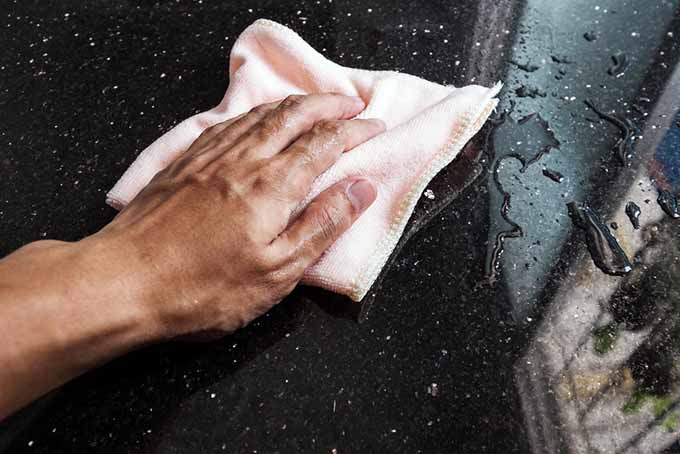
Dies hängt von der Nutzung der Messplatte und den Umgebungsbedingungen ab. Wir empfehlen, eine neue Messplatte oder ein Präzisionszubehör aus Granit innerhalb eines Jahres nach dem Kauf vollständig neu zu kalibrieren. Bei starker Beanspruchung der Granitmessplatte kann es ratsam sein, dieses Intervall auf sechs Monate zu verkürzen. Eine monatliche Überprüfung auf wiederkehrende Messfehler mit einer elektronischen Wasserwaage oder einem ähnlichen Gerät deckt beginnende Verschleißstellen auf und dauert nur wenige Minuten. Nach Feststellung der Ergebnisse der ersten Neukalibrierung kann das Kalibrierintervall je nach den Vorgaben Ihres internen Qualitätssystems verlängert oder verkürzt werden.
Wir bieten Ihnen einen Service an, der Ihnen bei der Inspektion und Kalibrierung Ihrer Granit-Messplatte hilft.

Es gibt mehrere mögliche Ursachen für Abweichungen zwischen den Kalibrierungen:
- Die Oberfläche wurde vor der Kalibrierung mit einer heißen oder kalten Lösung gewaschen und hatte nicht genügend Zeit zur Normalisierung.
- Die Platte ist nicht ordnungsgemäß abgestützt.
- Temperaturänderung
- Entwürfe
- Direkte Sonneneinstrahlung oder andere Strahlungswärme auf die Oberfläche des Tellers vermeiden. Sicherstellen, dass die Oberfläche nicht durch Deckenbeleuchtung erwärmt wird.
- Abweichungen im vertikalen Temperaturgradienten zwischen Winter und Sommer (Wenn möglich, sollte der vertikale Temperaturgradient zum Zeitpunkt der Kalibrierung bekannt sein.)
- Die Platte hatte nach dem Versand nicht genügend Zeit, sich zu normalisieren.
- Unsachgemäße Verwendung von Prüfgeräten oder Verwendung nicht kalibrierter Geräte
- Oberflächenveränderung infolge von Verschleiß
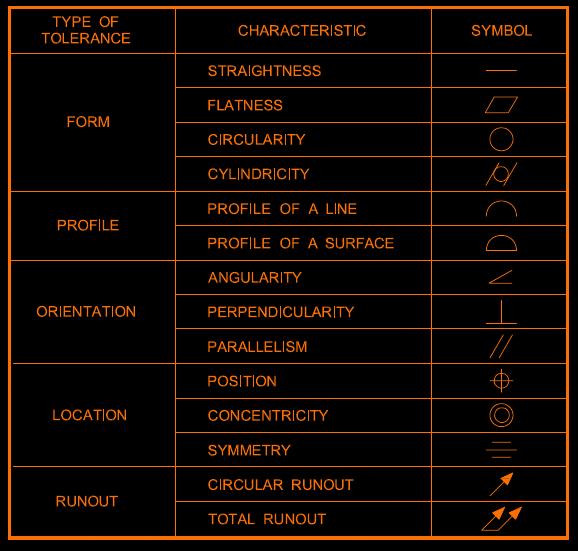
Wie viele verschiedene Locharten gibt es in Präzisionsgranit?
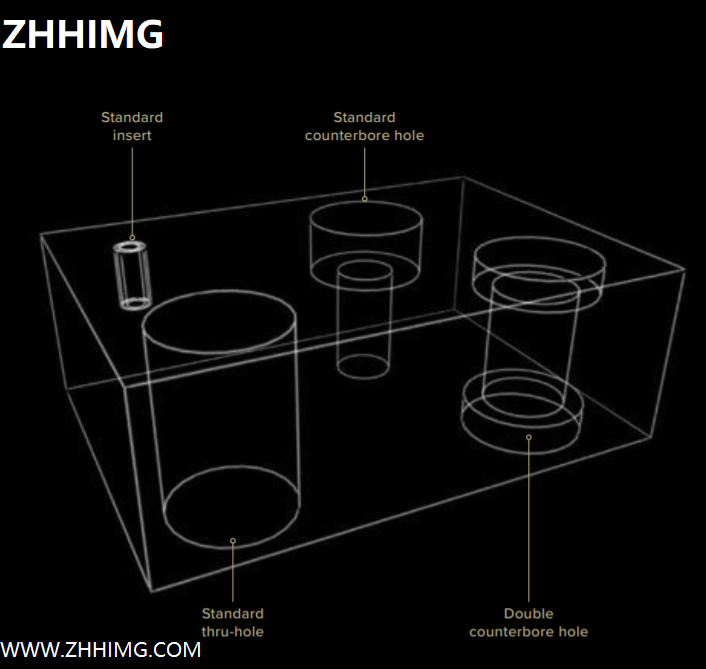
Schlitze an Präzisions-Granitkomponenten
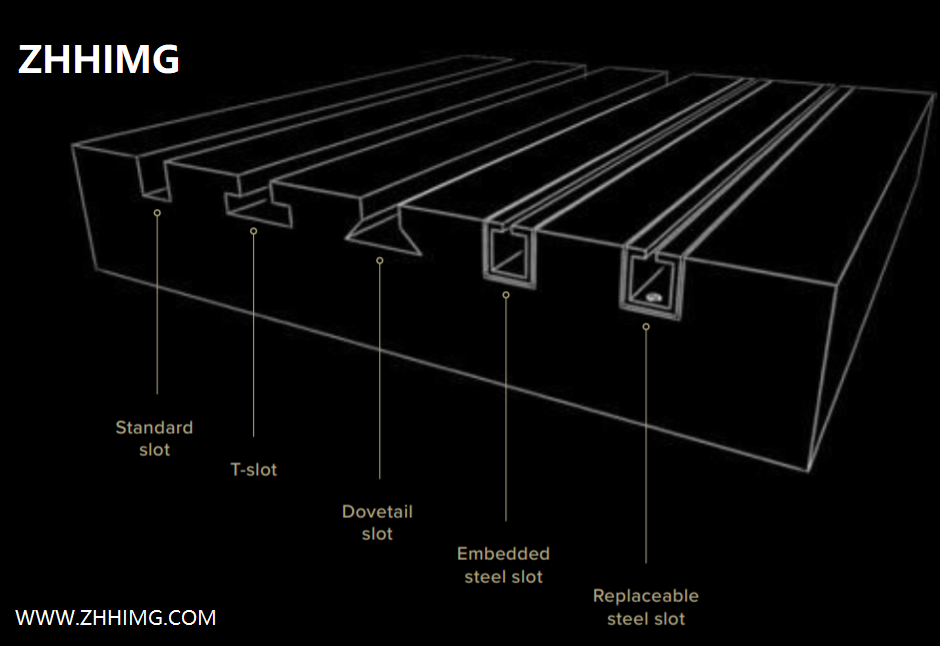
In vielen Fabriken, Prüfräumen und Laboren dienen Präzisions-Granitmessplatten als Grundlage für genaue Messungen. Da jede Längenmessung eine präzise Bezugsfläche voraussetzt, von der die Endmaße abgelesen werden, bieten Messplatten die optimale Referenzebene für die Werkstückprüfung und -ausrichtung vor der Bearbeitung. Sie eignen sich auch ideal als Basis für Höhenmessungen und die Prüfung von Messflächen. Darüber hinaus machen sie ihre hohe Ebenheit, Stabilität, Gesamtqualität und Verarbeitung zu einer guten Wahl für die Montage anspruchsvoller mechanischer, elektronischer und optischer Messsysteme. Für all diese Messprozesse ist die Kalibrierung der Messplatten unerlässlich.
Repeat Measurements and Flatness
Sowohl Ebenheit als auch Wiederholgenauigkeit sind entscheidend für eine präzise Oberfläche. Ebenheit bedeutet, dass alle Punkte der Oberfläche innerhalb zweier paralleler Ebenen liegen: der Grundebene und der Dachebene. Der Abstand zwischen diesen Ebenen gibt die Gesamtebenheit der Oberfläche an. Diese Ebenheitsmessung ist üblicherweise mit einer Toleranz versehen und kann eine Güteklasse enthalten.
The flatness tolerances for three standard grades are defined in the federal specification as determined by the following formula:
DIN-Norm, GB-Norm, ASME-Norm, JJS-Norm... jedes Land hat seine eigenen Standards...
In addition to flatness, repeatability must be ensured. A repeat measurement is a measurement of local flatness areas. It is a measurement taken anywhere on the surface of a plate that will repeat within the stated tolerance. Controlling local area flatness to a tighter tolerance than overall flatness guarantees a gradual change in surface flatness profile, thereby minimizing local errors.
Um sicherzustellen, dass eine Messplatte sowohl die Anforderungen an Ebenheit als auch an Wiederholgenauigkeit erfüllt, sollten Hersteller von Granitmessplatten die US-Bundesnorm GGG-P-463c als Grundlage für ihre Spezifikationen verwenden. Diese Norm behandelt die Wiederholgenauigkeit, die Materialeigenschaften von Granitmessplatten, die Oberflächenbeschaffenheit, die Position der Auflagepunkte, die Steifigkeit sowie zulässige Prüf- und Montageverfahren für Gewindeeinsätze.
Checking Plate Accuracy
Mit ein paar einfachen Richtlinien lässt sich die Investition in eine Granit-Messplatte über viele Jahre sichern. Je nach Nutzung, Werkstattumgebung und geforderter Genauigkeit variiert die Häufigkeit der Überprüfung. Als Faustregel gilt, dass eine neue Messplatte innerhalb eines Jahres nach dem Kauf vollständig neu kalibriert werden sollte. Bei häufiger Nutzung empfiehlt es sich, dieses Intervall auf sechs Monate zu verkürzen.
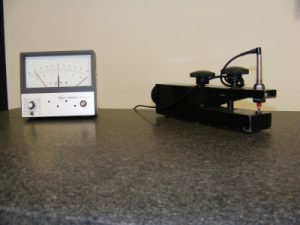
Before a surface plate has worn beyond specification for overall flatness, it will show worn or wavy posts. Monthly inspection for repeat measurement errors using a repeat reading gage will identify wear spots. A repeat reading gage is a high-precision instrument that detects local error and can be displayed on a high magnification electronic amplifier.
An effective inspection program should include regular checks with an autocollimator, providing actual calibration of overall flatness traceable to National Institute of Standards and Technology (NIST). Comprehensive calibration by the manufacturer or an independent company is necessary from time to time.
Variations Between Calibrations
In einigen Fällen treten Abweichungen zwischen den Kalibrierungen von Messplatten auf. Diese Abweichungen können durch Faktoren wie Oberflächenveränderungen infolge von Verschleiß, unsachgemäße Verwendung von Prüfgeräten oder die Verwendung nicht kalibrierter Geräte verursacht werden. Die beiden häufigsten Einflussfaktoren sind jedoch Temperatur und Auflagefläche.
One of the most important variables is temperature. For instance, the surface might have been washed with a hot or cold solution prior to calibration and not allowed sufficient time to normalize. Other causes of temperature change include drafts of cold or hot air, direct sunlight, overhead lighting or other sources of radiant heat on the surface of the plate.
There also can be variations in the vertical temperature gradient between winter and summer. In some cases, the plate is not allowed sufficient time to normalize after shipment. It is a good idea to record the vertical gradient temperature at the time the calibration is performed.
Another common cause for calibration variation is a plate that is improperly supported. A surface plate should be supported at three points, ideally located 20% of the length in from the ends of the plate. Two supports should be located 20% of the width in from the long sides, and the remaining support should be centered.
Only three points can rest solidly on anything but a precision surface. Attempting to support the plate at more than three points will cause the plate to receive its support from various combinations of three points, which will not be the same three points on which it was supported during production. This will introduce errors as the plate deflects to conform to the new support arrangement. Consider using steel stands with support beams designed to line up with the proper support points. Stands for this purpose are generally available from the surface plate manufacturer.
If the plate is properly supported, precise leveling is only necessary if an application specifies it. Leveling is not necessary to maintain the accuracy of a properly supported plate.
Extend Plate Life
Die Beachtung einiger weniger Richtlinien reduziert den Verschleiß einer Granit-Oberflächenplatte und verlängert letztendlich deren Lebensdauer.
Zunächst ist es wichtig, die Platte sauber zu halten. Abrasiver Staub aus der Luft ist in der Regel die Hauptursache für Verschleiß an einer Platte, da er sich leicht in Werkstücken und den Kontaktflächen von Messgeräten festsetzt.
It also is important to cover plates to protect it from dust and damage. Wear life can be extended by covering the plate when not in use.
Drehen Sie die Platte regelmäßig, um eine übermäßige Abnutzung einzelner Bereiche zu vermeiden. Es wird außerdem empfohlen, die Stahlkontaktflächen beim Messgerät durch Hartmetallkontaktflächen zu ersetzen.
Avoid setting food or soft drinks on the plate. Many soft drinks contain either carbonic or phosphoric acid, which can dissolve the softer minerals and leave small pits in the surface.
Where to Relap
Wenn eine Granitmessplatte nachbearbeitet werden muss, ist zu entscheiden, ob diese Arbeiten vor Ort oder im Kalibrierlabor durchgeführt werden sollen. Das Nachschleifen der Platte im Werk oder in einer spezialisierten Einrichtung ist stets vorzuziehen. Ist die Platte jedoch nicht zu stark abgenutzt (in der Regel innerhalb von 0,025 mm der geforderten Toleranz), kann sie vor Ort nachbearbeitet werden. Ist eine Platte jedoch so stark abgenutzt, dass die Toleranz um mehr als 0,025 mm überschritten wird, oder weist sie starke Poren oder Kerben auf, sollte sie vor dem Nachschleifen zum Werk geschickt werden.
A calibration facility has the equipment and factory setting providing the optimum conditions for proper plate calibration and rework if necessary.
Bei der Auswahl eines Technikers für Kalibrierung und Oberflächenbearbeitung vor Ort ist größte Sorgfalt geboten. Fragen Sie nach dessen Zertifizierung und vergewissern Sie sich, dass die von ihm verwendeten Geräte rückführbar kalibriert sind. Erfahrung spielt ebenfalls eine wichtige Rolle, da es jahrelange Erfahrung erfordert, das präzise Schleifen von Granit zu erlernen.
Critical measurements start with a precision granite surface plate as a baseline. By ensuring a reliable reference by using a properly calibrated surface plate, manufacturers have one of the essential tools for reliable measurements and better quality parts.Q
Checklist for Calibration Variations
1. Die Oberfläche wurde vor der Kalibrierung mit einer heißen oder kalten Lösung gewaschen und hatte nicht genügend Zeit, sich zu normalisieren.
2. Die Platte ist nicht ordnungsgemäß abgestützt.
3. Temperaturänderung.
4. Entwürfe.
5. Direkte Sonneneinstrahlung oder andere Strahlungswärme auf die Oberfläche des Tellers. Achten Sie darauf, dass die Oberfläche nicht durch Deckenbeleuchtung erwärmt wird.
6. Schwankungen des vertikalen Temperaturgradienten zwischen Winter und Sommer. Wenn möglich, sollte der vertikale Temperaturgradient zum Zeitpunkt der Kalibrierung ermittelt werden.
7. Der Platte wurde nach dem Versand nicht genügend Zeit zur Normalisierung gegeben.
8. Unsachgemäße Verwendung von Prüfgeräten oder Verwendung nicht kalibrierter Geräte.
9. Oberflächenveränderung infolge von Verschleiß.
Tech Tips
- Da jede lineare Messung von einer genauen Bezugsfläche abhängt, von der die endgültigen Maße abgenommen werden, bieten Messplatten die beste Bezugsebene für die Werkstückprüfung und das Layout vor der Bearbeitung.
- Controlling local area flatness to a tighter tolerance than overall flatness guarantees a gradual change in surface flatness profile, thereby minimizing local errors.
- Ein effektives Inspektionsprogramm sollte regelmäßige Kontrollen mit einem Autokollimator umfassen, der eine tatsächliche Kalibrierung der Gesamtebenheit ermöglicht, die auf die nationale Inspektionsbehörde rückführbar ist.
Granit besteht zu über 90 % aus Feldspat und Quarz, wobei Feldspat den größten Anteil ausmacht. Feldspat ist oft weiß, grau oder fleischrot, Quarz hingegen meist farblos oder gräulich-weiß. Diese beiden Minerale prägen die Grundfarbe des Granits. Feldspat und Quarz sind sehr hart und lassen sich selbst mit einem Stahlmesser nur schwer bearbeiten. Die dunklen Flecken im Granit bestehen hauptsächlich aus schwarzem Glimmer, enthalten aber auch andere Mineralien. Obwohl Biotit relativ weich ist, besitzt er eine beachtliche Festigkeit und kommt in Granit nur in geringen Mengen vor, oft unter 10 %. Diese Materialeigenschaften tragen maßgeblich zur besonderen Festigkeit des Granits bei.
Ein weiterer Grund für die Festigkeit von Granit liegt in der engen Verzahnung und Einbettung seiner Mineralpartikel. Die Poren machen oft weniger als 1 % des Gesamtvolumens des Gesteins aus. Dadurch ist Granit äußerst widerstandsfähig gegen hohen Druck und wird von Feuchtigkeit nur schwer durchdrungen.
Granitkomponenten bestehen aus rostfreiem, säure- und laugenbeständigem Stein mit hoher Verschleißfestigkeit und langer Lebensdauer und benötigen keine besondere Wartung. Granit-Präzisionskomponenten werden hauptsächlich im Werkzeugbau der Maschinenbauindustrie eingesetzt und daher auch als Granitkomponenten bezeichnet. Ihre Eigenschaften entsprechen im Wesentlichen denen von Granitplattformen. Einführung in die Werkzeugfertigung und Messung von Granit-Präzisionskomponenten: Präzisions- und Mikrobearbeitungstechnologien sind wichtige Entwicklungsrichtungen im Maschinenbau und gelten als wichtiger Indikator für ein hohes technologisches Niveau. Die Entwicklung von Spitzentechnologie und Verteidigungsindustrie ist untrennbar mit Präzisions- und Mikrobearbeitungstechnologien verbunden. Granitkomponenten lassen sich bei der Messung reibungslos und ohne Blockierung bewegen. Leichte Kratzer auf der Arbeitsfläche beeinträchtigen die Messgenauigkeit nicht. Granitkomponenten müssen entsprechend den Anforderungen des Auftraggebers konstruiert und gefertigt werden.
Anwendungsbereich:
Wie wir alle wissen, werden immer mehr Maschinen und Anlagen mit Präzisionsgranitkomponenten ausgestattet.
Granitkomponenten werden für dynamische Bewegungen, Linearmotoren, Koordinatenmessgeräte, CNC-Maschinen, Lasermaschinen usw. verwendet.
Gerne können Sie uns für weitere Informationen kontaktieren.
Messgeräte und mechanische Bauteile aus Granit werden aus hochwertigem Jinan-Schwarzgranit gefertigt. Aufgrund ihrer hohen Präzision, Langlebigkeit, guten Stabilität und Korrosionsbeständigkeit finden sie zunehmend Anwendung in der Produktprüfung moderner Industrien sowie in wissenschaftlichen Bereichen wie Maschinenbau, Luft- und Raumfahrt und Forschung.
Vorteile
Doppelt so hart wie Gusseisen;
----Minimale Dimensionsänderungen sind auf Temperaturänderungen zurückzuführen;
----Ohne Auswringen, sodass die Arbeit nicht unterbrochen wird;
----Frei von Graten oder Vorsprüngen dank der feinen Kornstruktur und der geringen Klebrigkeit, was eine hohe Planheit über eine lange Lebensdauer gewährleistet und andere Teile oder Instrumente nicht beschädigt;
----Problemloser Betrieb bei Verwendung mit magnetischen Materialien;
Lange Lebensdauer und rostfrei, was zu geringen Wartungskosten führt.
Die Präzisions-Granit-Messplatten werden auf höchste Ebenheit präzise geläppt, um Genauigkeit zu erzielen, und dienen als Basis für die Montage anspruchsvoller mechanischer, elektronischer und optischer Messsysteme.
Einige der einzigartigen Merkmale der Granit-Oberflächenplatte:
Gleichmäßigkeit der Härte;
Genau auch unter Lastbedingungen;
Vibrationsabsorbierend;
Leicht zu reinigen;
Schutz vor Verwicklungen;
Geringe Porosität;
Nicht scheuernd;
Nichtmagnetisch
Vorteile der Granit-Oberflächenplatte
First, the rock after a long period of natural aging, uniform structure, coefficient minimum, the internal stress completely disappear, not deformed, so the precision is high.
E-Mail senden
Skype
Englisch
Deutsch
Französisch
Portugiesisch
Spanisch
japanisch
Koreanisch
Arabisch
irisch
griechisch
Türkisch
Italienisch
dänisch
rumänisch
Indonesisch
tschechisch
Schwedisch
Polieren
baskisch
katalanisch
Esperanto
Hindi
Lao
albanisch
Amharisch
Armenisch
Aserbaidschanisch
Belarussisch
PBengali
bosnisch
bulgarisch
Cebuano
Chichewa
Korsisch
kroatisch
Niederländisch
estnisch
Filipino
finnisch
Friesisch
galizisch
georgisch
Gujarati
haitianisch
Hausa
hawaiischhebräischHmong
ungarischisländischIgbo
JavanischKannada
Kasachisch
Khmer
kurdisch
Kirgisen
lateinisch
lettisch
litauisch
Luxemburg..
mazedonisch
Madagassisch
malaiisch
Malayalam
maltesisch
Maori
Marathi
mongolisch
birmanisch
Nepali
norwegisch
Paschtu
persisch
Punjabi
serbisch
Sesotho
Singhalesisch
slowakisch
- Slowenisch
- somali
- Samoan
- Schottisch-Gälisch
- Shona
- Sindhi
- Sundanesen
- Suaheli
- Tadschikisch
- Tamil
- Telugu
Thai
ukrainisch
UrduAUsbekisch2VietnamesischLWalisischAXhosa
Jiddisch
Yoruba
Zulu
Kinyarwanda
Tatarisch
Turkmen
Uigurisch
chinesisch
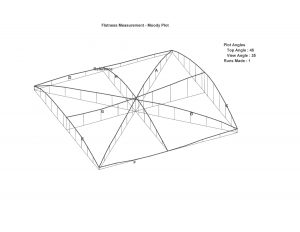
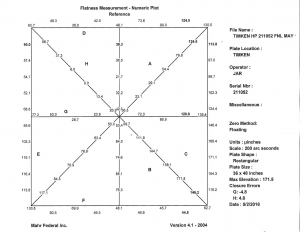
Routine surface plate calibration is necessary to ensure flatness and repeatability over time. The precision measurement group at Cross is ISO 17025 accredited for calibration of surface plate flatness and repeatability. We utilize the Mahr Surface Plate Certification System featuring:
- Moody and Profile Analysis,
- Isometric or Numeric plots,
- Multiple Run Average, and
- Automatic Grading According to Industry Standards.
The Mahr Computer Assisted Model determines any angular or linear deviation from absolute level, and is ideally suited for highly precise profiling of surface plates.
Intervals between calibrations will vary depending on the frequency of use, the environmental conditions where the plate is located, and the specific quality requirements of your company. Properly maintaining your surface plate may allow for longer intervals between each calibration, helps you avoid the added cost of relapping, and most importantly ensures the measurements you obtain on the plate are as accurate as possible. Although surface plates appear robust, they are precision instruments and should be treated as such. Here are some things to consider regarding care of your surface plates:
- Keep the plate clean, and if possible cover it when it is not in use
- Nothing should be placed on the plate other than gages or pieces to be measured.
- Don’t use the same spot on the plate every time.
- If possible, rotate the plate periodically.
- Respect the load limit of your plate
Precision Granite Base Can Improve Machine Tool Performances
Requirements are constantly increasing in mechanical engineering in general and in machine tool construction in particular. Achieving maximum precision and performance values without increasing costs are constant challenges to being competitive. The machine tool bed is a decisive factor here. Therefore, more and more machine tool manufacturers are relying on granite. Due to its physical parameters, it offers clear advantages that cannot be achieved with steel or polymer concrete.
Granite is a so-called volcanic deep rock and has a very dense and homogeneous structure with an extremely low coefficient of expansion, low thermal conductivity and high vibration damping.
Below you will discover why the common opinion that granite is mainly only suitable as machine base for high-end coordinate measuring machines is long outdated and why this natural material as a machine tool base is a very advantageous alternative to steel or cast iron even for high-precision machine tools.
We can manufacture granite components for dynamic motion, granite components for linear motors, granite components for ndt, granite components for xray, granite components for cmm, granite components for cnc, granite precision for laser, granite components for aerospace, granite components for precision stages...
High Added Value Without Additional Costs
The increasing use of granite in mechanical engineering is not so much due to the massive increase in the price of steel. Rather, it is because the added value for the machine tool achieved with a machine bed made of granite is possible at very little or no extra cost. This is proven by cost comparisons of well-known machine tool manufacturers in Germany and Europe.
The considerable gain in thermodynamic stability, vibration damping and long-term precision made possible by granite cannot be achieved with a cast iron or steel bed, or only at relatively high cost. For example, thermal errors can account for up to 75% of the total error of a machine, with compensation often attempted for by software – with moderate success. Due to its low thermal conductivity, granite is the better foundation for long-term precision.
With a tolerance of 1 μm, granite easily meets the flatness requirements according to DIN 876 for the degree of accuracy 00. With a value of 6 on the hardness scale 1 to 10, it is extremely hard, and with its specific weight of 2.8g/cm³ it almost reaches the value of aluminium. This also results in additional advantages such as higher feed rates, higher axis accelerations and an extension of the tool life for cutting machine tools. Thus, the change from a cast bed to a granite machine bed moves the machine tool in question into the high-end class in terms of precision and performance – at no extra cost.
Granite’s Improved Ecological Footprint
In contrast to materials such as steel or cast iron, natural stone does not have to be produced with a great deal of energy and using additives. Only relatively small amounts of energy are required for quarrying and surface treatment. This results in a superior ecological footprint, which even at the end of a machine’s life surpasses that of steel as a material. The granite bed can be the basis for a new machine or be used for completely different purposes such as shredding for road construction.
Nor are there any shortages of resources for granite. It is a deep rock formed from magma within the earth’s crust. It has ‘matured’ for millions of years and is available in very large quantities as a natural resource on almost all continents, including all of Europe.
Conclusion: The numerous demonstrable advantages of granite compared to steel or cast iron justify the increasing willingness of mechanical engineers to use this natural material as a foundation for high-precision, high-performance machine tools. Detailed information about granite properties, which are advantageous for machine tools and mechanical engineering, can be found in this further article.
A repeat measurement is a measurement of local flatness areas. The Repeat Measurement specification states that a measurement taken anywhere on the surface of a plate will repeat within the stated tolerance. Controlling local area flatness tighter than overall flatness guarantees a gradual change in surface flatness profile thereby minimizing local errors.
Most manufacturers, including imported brands, adhere to the Federal Specification of overall flatness tolerances but many overlook the repeat measurements. Many of the low value or budget plates available in the market today will not guarantee repeat measurements. A manufacturer who does not guarantee repeat measurements is NOT producing plates that meet the requirements of ASME B89.3.7-2013 or Federal Specification GGG-P-463c, or DIN 876, GB, JJS...
Both are critical to ensure a precision surface for accurate measurements. Flatness specification alone is not sufficient to guarantee measurement accuracy. Take as an example, a 36 X 48 Inspection Grade A surface plate, which meets ONLY the flatness specification of .000300". If the piece being checked bridges several peaks, and the gage being used is in a low spot, the measurement error could be the full tolerance in one area, 000300"! Actually, it can be much higher if the gage is resting on the slope of an incline.
Errors of .000600"-.000800" are possible, depending upon the severity of the slope, and the arm length of the gage being used. If this plate had a Repeat Measurement specification of .000050"F.I.R. then the measurement error would be less than .000050" regardless of where the measurement is taken on the plate. Another problem, which usually arises when an untrained technician attempts to resurface a plate on-site, is the use of Repeat Measurements alone to certify a plate.
The instruments that are used to verify repeatability are NOT designed to check overall flatness. When set to zero on a perfectly curved surface, they will continue to read zero, whether that surface is perfectly flat or perfectly concave or convex 1/2"! They simply verify the uniformity of the surface, not the flatness. Only a plate that meets both the flatness specification AND the repeat measurement specification truly meets the requirements of ASME B89.3.7-2013 or Federal Specification GGG-P-463c.
Ask us about or flatness specification and repeat measurement promise by calling +86 19969991659 or emailing INFO@ZHHIMG.COM
Yes, but they can only be guaranteed for a specific vertical temperature gradient. The effects of thermal expansion on the plate could easily cause a change in accuracy greater than the tolerance if there is a change in the gradient. In some cases, if the tolerance is tight enough, the heat absorbed from overhead lighting can cause enough of a gradient change over several hours.
Granite has a coefficient of thermal expansion of approximately .0000035 inches per inch per 1°F. As an example: A 36" x 48" x 8" surface plate has an accuracy of .000075" (1/2 of Grade AA) at a gradient of 0°F, the top and bottom are the same temperature. If the top of the plate warms up to the point where it is 1°F warmer than the bottom, the accuracy would change to .000275" convex ! Therefore, ordering a plate with a tolerance tighter than Laboratory Grade AA should only be considered if there is adequate climate control.
A surface plate should be supported at 3 points, ideally located 20% of the length in from the ends of the plate. Two supports should be located 20% of the width in from the long sides, and the remaining support should be centered. Only 3 points can rest solidly on anything but a precision surface.
The plate should be supported at these points during production, and it should be supported only at these three points while in use. Attempting to support the plate at more than three points will cause the plate to receive its support from various combinations of three points, which will not be the same 3 points on which it was supported during production. This will introduce errors as the plate deflects to conform to the new support arrangement. All zhhimg steel stands have support beams designed to line up with the proper support points.
If the plate is properly supported, precise leveling is only necessary if your application calls for it. Leveling is not necessary to maintain the accuracy of a properly supported plate.
Why Choose Granite for Machine Bases and Metrology Components?
The answer is 'yes' for almost every application. The advantages of granite include: No rust or corrosion, almost immune to warping, no compensating hump when nicked, longer wear life, smoother action, greater precision, virtually non-magnetic, low co-efficient of thermal expansion, and low maintenance cost.
Granite is a type of igneous rock quarried for its extreme strength, density, durability, and resistance to corrosion. But granite is also very versatile– it’s not just for squares and rectangles! In fact, Starrett Tru-Stone confidently works with granite components engineered in shapes, angles, and curves of all variations on a regular basis—with excellent outcomes.
Through our state of the art processing, cut surfaces can be exceptionally flat. These qualities make granite the ideal material to create custom-size and custom-design machine bases and metrology components. Granite is:
machineable
precisely flat when cut and finished
rust resistant
durable
long lasting
Granite components are also easy to clean. When creating custom designs, be sure to choose granite for its superior benefits.
STANDARDS / HIGH WEAR APPLICATIONS
The granite utilized by ZhongHui for our standard surface plate products has high quartz content, which provides greater resistance to wear and damage. Our Superior Black and Crystal Pink colors have low water absorption rates, minimizing the possibility of your precision gages rusting while setting on the plates. The colors of granite offered by ZhongHui result in less glare, which means less eyestrain for individuals using the plates. We have chosen our granite types while considering thermal expansion in an effort to keep this aspect minimal.
CUSTOM APPLICATIONS
When your application calls for a plate with custom shapes, threaded inserts, slots or other machining, you’ll want to select a material like Black Diabase. This natural material offers superior stiffness, excellent vibration dampening, and improved machinability.
Yes, if they are not too badly worn. Our factory setting and equipment allow the optimum conditions for proper plate calibration and rework if necessary. Generally, if a plate is within .001" of the required tolerance, it can be resurfaced on-site. If a plate is worn to the point where it is more than .001" out of tolerance, or if it is badly pitted or nicked, then it will need to be sent to the factory for grinding prior to relapping.
Great care should be exercised in selecting an on-site calibration and resurfacing technician. We urge you to use caution in selecting your calibration service. Ask for accreditation and verify the equipment that the technician will use has a National Inspection Institution traceable calibration. It takes many years to learn how to properly lap precision granite.
ZhongHui provides quick turn-around on calibrations performed in our factory. Send your plates in for calibration if possible. Your quality and reputation depend on the accuracy of your measurement instruments including surface plates!
Our black surface plates have a significantly higher density and are up to three times as stiff. Therefore, a plate made of the black does not need to be as thick as a granite plate of the same size to have equal or greater resistance to deflection. Reduced thickness means less weight and lower shipping costs.
Beware of others who use lower quality black granite in the same thickness. As stated above, properties of granite, like wood or metal, vary by material and color, and is not an accurate predictor of stiffness, hardness, or wear resistance. In fact, many types of black granite and diabase are very soft and not suitable for surface plate applications.
No. The specialized equipment and training necessary to rework these items requires that they be returned to the factory for calibration and rework.
Yes. Ceramic and granite have similar characteristics, and the methods used to calibrate and lap granite can be used with ceramic items as well. Ceramics are more difficult to lap than granite resulting in a higher cost.
Yes, provided that the inserts are recessed below the surface. If steel inserts are flush with, or above the surface plane, they must be spot-faced down before the plate can be lapped. If required, we can provide that service.
Yes. Steel inserts with the desired thread (English or metric) can be epoxy bonded into the plate at the desired locations. ZhongHui uses CNC machines to provide the tightest insert locations within +/- 0.005”. For less critical inserts, our locational tolerance for threaded inserts is ±.060". Other options include steel T-Bars and dovetail slots machined directly into the granite.
Inserts that are properly bonded using high strength epoxy and good workmanship will withstand a great deal of torsional and shear force. In a recent test, using 3/8"-16 threaded inserts, an independent testing laboratory measured the force required to pull an epoxy-bonded insert from a surface plate. Ten plates were tested. Out of these ten, in nine cases, the granite fractured first. The average load at the point of failure was 10,020 lbs. for gray granite and 12,310 lbs. for black. In the single case where an insert pulled free of the plate, the load at the point of failure was 12,990 lbs.! If a work piece forms a bridge across the insert and extreme torque is applied, it is possible to generate enough force to fracture the granite. Partially for this reason, ZhongHui gives guidelines for the maximum safe torque that can be applied the epoxy bonded inserts: https://www.zhhimg.com/standard-thread-inserts-product/
Yes, but only at our factory. At our plant, we can restore almost any plate to 'like-new' condition, usually for less than half the cost of replacing it. Damaged edges can be cosmetically patched, deep grooves, nicks, and pits can be ground out, and the attached supports can be replaced. In addition, we can modify your plate to increase its versatility by adding solid or threaded steel inserts and cutting slots or clamping lips, per your specifications.
Why Choose Granite?
Granite is a type of igneous rock formed in the Earth millions of years ago. The composition of igneous rock contained many minerals such as quartz that is extremely hard and wear-resistant. In addition to hardness and wear resistance granite has approximately half the coefficient of expansion as cast iron. As its volumetric weight is approximately one third that of cast iron, granite is easier to manoeuvre.
For machine bases and metrology components, black granite is the colour most used. Black granite has a higher percentage of quartz than other colours and is, therefore, the hardest wearing.
Granite is cost-effective, and cut surfaces can be exceptionally flat. Not only can it be hand lapped to achieve extremes of accuracy, but re-conditioning can be performed without moving the plate or table off-site. It is entirely a hand lapping operation and generally costs much less than re-conditioning a cast iron alternative.
These qualities make granite the ideal material to create custom-size and custom-design machine bases and metrology components such as the granite surface plate.
ZhongHui produces bespoke granite products that are created to support specific measurement requirements. These bespoke items vary from straight edges to tri squares. Due to the versatile nature of granite, the components can be produced to any size required; they are hard wearing and long-lasting.
Advantages of Granite Surface Plates
The importance of measuring on an even surface was established by British inventor Henry Maudsley in the 1800s. As a machine tool innovator, he determined that consistent production of parts required a solid surface for reliable measurements.
The industrial revolution created a demand for measuring surfaces, so engineering company Crown Windley created manufacturing standards. The standards for surface plates were first set by Crown in 1904 using metal. As the demand and cost for metal increased, alternative materials for the measuring surface were investigated.
In America, monument creator Wallace Herman established that black granite was an excellent surface plate material alternative to metal. As granite is non-magnetic and doesn’t rust, it soon became the preferred measuring surface.
A granite surface plate is an essential investment for laboratories and test facilities. A granite surface plate of 600 x 600 mm can be mounted on a support stand. The stands provide a working height of 34” (0.86m) with five adjustable points for levelling.
For reliable and consistent measurement results, a granite surface plate is crucial. As the surface is a smooth and stable plane, it enables instruments to be carefully manipulated.
The main advantages of granite surface plates are:
• Non-reflective
• Resistant to chemicals and corrosion
• Low coefficient of expansion compared with cart iron so less affected by temperature change
• Naturally rigid and hard-wearing
• The plane of the surface is unaffected if scratched
• Will not rust
• Non-magnetic
• Easy to clean and maintain
• Calibration and resurfacing can be done onsite
• Suitable for drilling for threaded support inserts
• High vibration damping
For many shops, inspection rooms and laboratories, precision granite surface plates are relied on as the basis for accurate measurement. Because every linear measurement depends on an accurate reference surface from which final dimensions are taken, surface plates provide the best reference plane for work inspection and layout prior to machining. They also are ideal bases for making height measurements and gaging surfaces. Further, a high degree of flatness, stability, overall quality and workmanship make them a good choice for mounting sophisticated mechanical, electronic and optical gaging systems. For any of these measurement processes, it is imperative to keep surface plates calibrated.
Repeat Measurements and Flatness
Both flatness and repeat measurements are critical to ensure a precision surface. Flatness can be considered as all points on the surface being contained within two parallel planes, the base plane and the roof plane. The measurement of distance between the planes is the overall flatness of the surface. This flatness measurement commonly carries a tolerance and may include a grade designation.
The flatness tolerances for three standard grades are defined in the federal specification as determined by the following formula:
Laboratory Grade AA = (40 + diagonal² / 25) x 0.000001 inch (unilateral)
Inspection Grade A = Laboratory Grade AA x 2
Tool Room Grade B = Laboratory Grade AA x 4
In addition to flatness, repeatability must be ensured. A repeat measurement is a measurement of local flatness areas. It is a measurement taken anywhere on the surface of a plate that will repeat within the stated tolerance. Controlling local area flatness to a tighter tolerance than overall flatness guarantees a gradual change in surface flatness profile, thereby minimizing local errors.
To ensure a surface plate meets both the flatness and repeat measurement specifications, manufacturers of granite surface plates should use Federal Specification GGG-P-463c as a basis for their specifications. This standard addresses repeat measurement accuracy, material properties of surface plate granites, surface finish, support point location, stiffness, acceptable methods of inspection and installation of threaded inserts.
Before a surface plate has worn beyond specification for overall flatness, it will show worn or wavy posts. Monthly inspection for repeat measurement errors using a repeat reading gage will identify wear spots. A repeat reading gage is a high-precision instrument that detects local error and can be displayed on a high magnification electronic amplifier.
Checking Plate Accuracy
By following a few simple guidelines, an investment in a granite surface plate should last for many years. Depending on plate usage, shop environment and required accuracy, frequency of checking the surface plate accuracy varies. A general rule of thumb is for a new plate to receive a full recalibration within one year of purchase. If the plate is used frequently, it is advisable to shorten this interval to six months.
Before a surface plate has worn beyond specification for overall flatness, it will show worn or wavy posts. Monthly inspection for repeat measurement errors using a repeat reading gage will identify wear spots. A repeat reading gage is a high-precision instrument that detects local error and can be displayed on a high magnification electronic amplifier.
An effective inspection program should include regular checks with an autocollimator, providing actual calibration of overall flatness traceable to National Institute of Standards and Technology (NIST). Comprehensive calibration by the manufacturer or an independent company is necessary from time to time.
Variations Between Calibrations
In some cases, there are variations between surface plate calibrations. Sometimes factors such as surface change resulting from wear, incorrect use of inspection equipment or use of noncalibrated equipment can account for these variations. The two most common factors, however, are temperature and support.
One of the most important variables is temperature. For instance, the surface might have been washed with a hot or cold solution prior to calibration and not allowed sufficient time to normalize. Other causes of temperature change include drafts of cold or hot air, direct sunlight, overhead lighting or other sources of radiant heat on the surface of the plate.
There also can be variations in the vertical temperature gradient between winter and summer. In some cases, the plate is not allowed sufficient time to normalize after shipment. It is a good idea to record the vertical gradient temperature at the time the calibration is performed.
Another common cause for calibration variation is a plate that is improperly supported. A surface plate should be supported at three points, ideally located 20% of the length in from the ends of the plate. Two supports should be located 20% of the width in from the long sides, and the remaining support should be centered.
Only three points can rest solidly on anything but a precision surface. Attempting to support the plate at more than three points will cause the plate to receive its support from various combinations of three points, which will not be the same three points on which it was supported during production. This will introduce errors as the plate deflects to conform to the new support arrangement. Consider using steel stands with support beams designed to line up with the proper support points. Stands for this purpose are generally available from the surface plate manufacturer.
If the plate is properly supported, precise leveling is only necessary if an application specifies it. Leveling is not necessary to maintain the accuracy of a properly supported plate.
It is important to keep the plate clean. Airborne abrasive dust is usually the greatest source of wear and tear on a plate, as it tends to embed in workpieces and the contact surfaces of gages. Cover plates to protect them from dust and damage. Wear life can be extended by covering the plate when not in use.
Extend Plate Life
Following a few guidelines will reduce wear on a granite surface plate and ultimately, extend its life.
First, it is important to keep the plate clean. Airborne abrasive dust is usually the greatest source of wear and tear on a plate, as it tends to embed in workpieces and the contact surfaces of gages.
It also is important to cover plates to protect it from dust and damage. Wear life can be extended by covering the plate when not in use.
Rotate the plate periodically so that a single area does not receive excessive use. Also, it is recommended to replace steel contact pads on gaging with carbide pads.
Avoid setting food or soft drinks on the plate. Many soft drinks contain either carbonic or phosphoric acid, which can dissolve the softer minerals and leave small pits in the surface.
Where to Relap
When a granite surface plate needs re-surfacing, consider whether to have this service performed on-site or at the calibration facility. It is always preferable to have the plate relapped at the factory or a dedicated facility. If, however, the plate is not too badly worn, generally within 0.001 inch of the required tolerance, it can be resurfaced on-site. If a plate is worn to the point where it is more than 0.001 inch out of tolerance, or if it is badly pitted or nicked, then it should be sent to the factory for grinding prior to relapping.
A calibration facility has the equipment and factory setting providing the optimum conditions for proper plate calibration and rework if necessary.
Great care should be exercised in selecting an on-site calibration and resurfacing technician. Ask for accreditation and verify the equipment that the technician will use has a NIST-traceable calibration. Experience also is an important factor, as it takes many years to learn how to correctly lap precision granite.
Critical measurements start with a precision granite surface plate as a baseline. By ensuring a reliable reference by using a properly calibrated surface plate, manufacturers have one of the essential tools for reliable measurements and better quality parts.
Checklist for Calibration Variations
- The surface was washed with a hot or cold solution prior to calibration and was not allowed sufficient time to normalize.
- The plate is improperly supported.
- Temperature change.
- Drafts.
- Direct sunlight or other radiant heat on the surface of the plate. Be sure that overhead lighting is not heating the surface.
- Variations in the vertical temperature gradient between winter and summer. If at all possible, know the vertical gradient temperature at the time the calibration is performed.
- Plate not allowed sufficient time to normalize after shipment.
- Improper use of inspection equipment or use of noncalibrated equipment.
- Surface change resulting from wear.
Tech Tips
Because every linear measurement depends on an accurate reference surface from which final dimensions are taken, surface plates provide the best reference plane for work inspection and layout prior to machining.
Controlling local area flatness to a tighter tolerance than overall flatness guarantees a gradual change in surface flatness profile, thereby minimizing local errors.